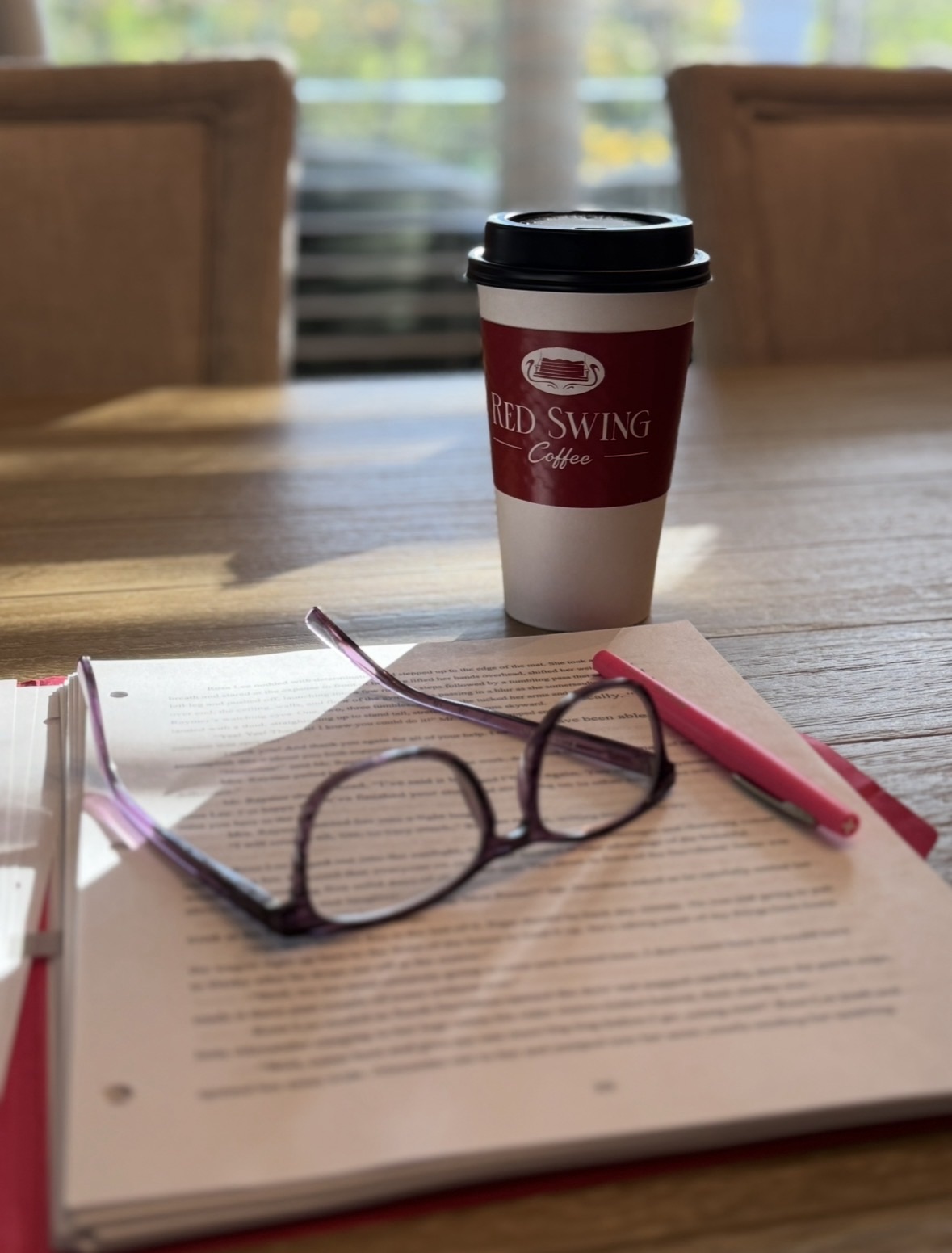

As I’m waiting for edits to come back on my manuscript and preparing for all of the book launch shenanigans that come with releasing a new novel into the wild, I’ve been catching up on email newsletters and rereading Stephen King’s On Writing: A Memoir of the Craft (Side note: This book is a must-read for King fans and for anyone who writes anything, ever.).
I came across an essay called “Keep Your Darlings” by Ann Vodicka in The Brevity Blog in my inbox. Now, if you’ve been a writer for more than a minute, you’ve heard that oft-repeated piece of advice: You must be willing to cut, cut, cut during the editing process – cut anything extraneous, anything that doesn’t move the plot forward or add to the character development, cut everything that isn’t absolutely essential, even if that means a section, sentence, or phrase that you are particularly fond of (i.e., your “darlings”).
According to Vodicka, this piece of advice originated in a 1914 lecture by Sir Arthur Quiller-Couch. He encouraged writers to “Murder your darlings,” a command William Faulkner would later shorten to “kill your darlings.”
This advice has been passed on from writer to writer for years, a variation of it even appearing in the Stephen King book I’m currently reading.
The popularity of this expression means writers I follow on social media often brag about the thousands of words they deleted from a work in progress, as if it’s a badge of honor.
I’ve always found this concept strange. As an educator, I spent countless hours counseling students to add more description to their writing, to experiment with compound and complex sentences (or, the piece de resistance, compound-complex sentences), to add depth and variety to their writing, to “show, don’t tell,” to use dialogue and details to paint a vivid picture in the reader’s mind.
Yet, some of that advice I gave goes against this wisdom from successful authors and publishers over the past 100 years. Producing writing that has lengthy descriptive details or (gasp!) adverbs seems to be a no-no.
I appreciate Vodicka’s take on this: “I’ve never liked it… The notion that we ought to destroy what delights us, and how this encourages a writer to not only doubt her instincts but fundamentally distrust them.”
Vodicka views writing with reverence, referring to it as “an act of empathy” and “spiritual.” These feelings seem at odds with the notion of deleting words you have pored over, a passage you have rearranged and reworked until it provokes just the right feel for a reader. How could you put your blood, sweat, and tears (literally) into a piece of literary art, only to then slash through it with a sharp knife, deleting ideas, thoughts, and descriptions that once seemed worth recording in print?
One of my favorite points Vodicka makes is that this idea of “killing your darlings” perpetuates “writing of a certain style (Western, white, male).” She encourages her readers to “…remember that publishing is an industry forged by men who fought wars, who survived dominance, violence, and bravado with detachment – who enacted and enshrined a specific code of masculinity and constructed the can(non) inside of it.”
Wow.
I had never considered where this idea of stripping a passage of writing down to the bare bones originated from, but the American publishing and literary titans of the early 20th Century were certainly masters of this concept of precision and plain-spoken writing (I’m looking at you, Hemingway). It seems it was a complete turnabout from many of the previous century’s popular writers, including Charles Dickens, Henry James, and Victor Hugo, who seemed to love writing verbose descriptions and complex, never-ending sentences.
And yes, many famous American early 20th Century authors like Hemingway and Steinbeck experienced war firsthand. The predominant idea of masculinity at the time was very much one of efficiency and facts – certainly no one had time for empathy and emotion when there were wars and an economic depression happening, for goodness’ sake!
It’s interesting to note that as we moved into the 21st Century, ideas of modern masculinity evolved simultaneously. At the same time, more women are writing and publishing now than ever, and more women are reading, thanks to social media (see the popularity of BookTok and Bookstagram accounts, for example).
I think it’s no coincidence that as the publishing industry has been overtaken by female writers, some of the most popular books now are often hefty tomes in the fantasy or romantasy genres. Many feature 100,000 or more words, and most are part of a series. Even popular suspense novels are frequently part of a series, or at least have a sequel.
Writers today have a lot to say, and readers are here for it!
Of course, all of this is not meant to say that you should never cut a word, phrase, or sentence (or even a whole scene or chapter) during the editing process. Many times, hidden gems in a first draft can be polished to a shine by getting rid of some of the “fluff” threatening to bury them.
I think the important thing is to make sure that whatever you cut is truly worth losing, and maybe be just a little more careful with the scalpel when making those incisions (And for the record, there were 5 adverbs in that last sentence, and I’m keeping them all).


I have not heard of the “Keep Your Darlings” book. Interesting premise to it! I suspect that some of the tendency to cut words comes from monetary considerations, too.
LikeLiked by 1 person